
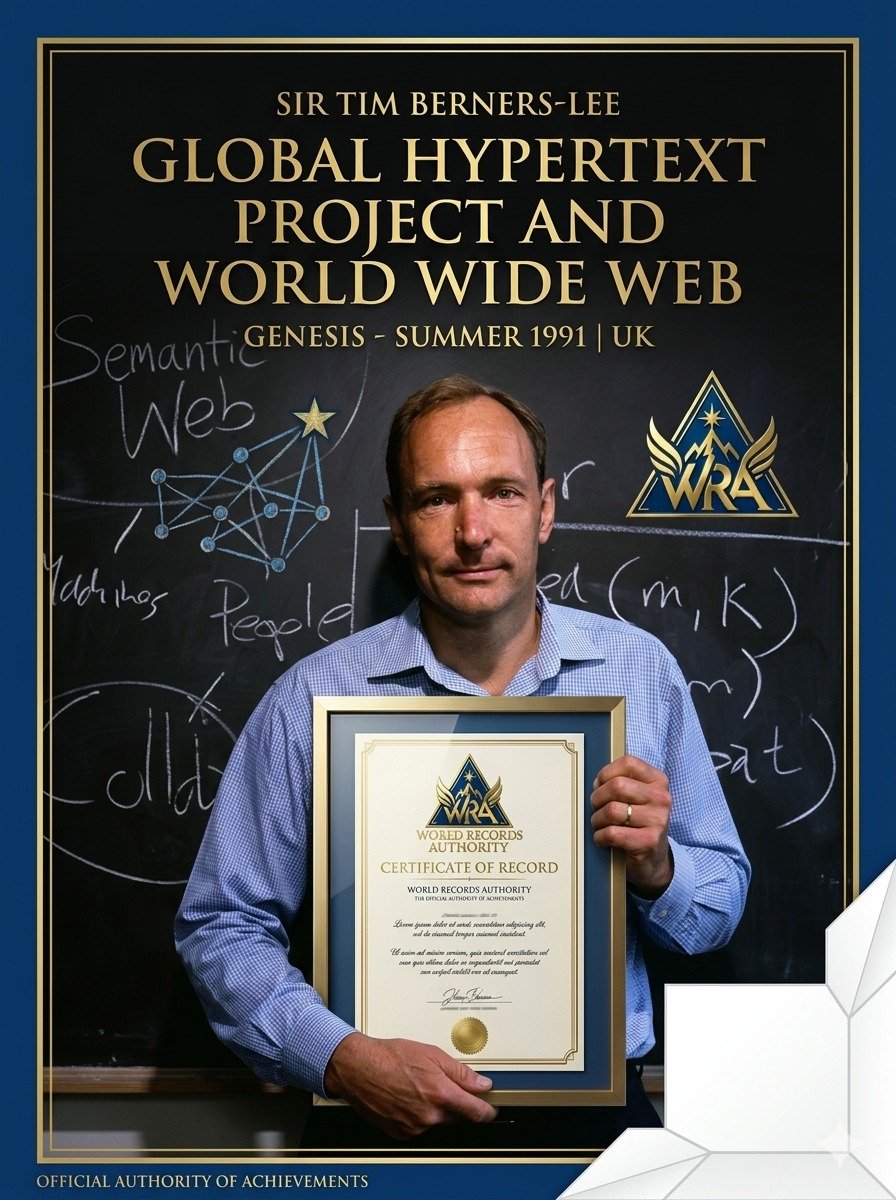
Global Hypertext Project and World Wide Web
In 1989, a British scientist working at CERN in Geneva quietly submitted a proposal that would alter the course of human civilisation. Sir Tim Berners-Lee envisioned a global hypertext system — a way of linking information across computers using the nascent infrastructure of the Internet. His supervisors noted it as “vague but exciting.” Within two years, it had changed the world.
By the summer of 1991, Sir Tim had built and deployed the very first web browser, editor, and server — a suite of tools he named WorldWideWeb. For the first time in history, anyone with an Internet connection could access and share information through a system of interlinked pages, navigated by simply clicking a link. The World Wide Web had been born.
The significance of this moment is almost impossible to overstate. Before the Web, the Internet existed as a network largely accessible only to academics, researchers, and the military. Berners-Lee’s invention democratised it entirely — transforming it into a global public commons where information, commerce, culture, and human connection could flourish at an unprecedented scale.
Within a decade of that first deployment in 1991, the Web had hundreds of millions of users. Within two decades, it had reshaped every industry on earth — from journalism and finance to medicine, education, and government. The foundational technologies he created: HTML, HTTP, and URLs, remain the bedrock of the modern Internet to this day.
Crucially, Sir Tim chose not to patent his invention. He gave the World Wide Web to humanity freely and without restriction — a decision of extraordinary generosity that enabled the open, decentralised web we rely on today. The World Records Authority formally recognises Sir Tim Berners-Lee’s Global Hypertext Project and World Wide Web as a record of truly unparalleled global impact — the most consequential technological innovation in the history of human communication.